The Girl Scout Silver Award is the highest honor a Girl Scout Cadette can achieve. Cadettes gain the confidence and skills that will catapult them to lifelong success by focusing on an issue they care about, learning the facts, and taking action to make a difference.
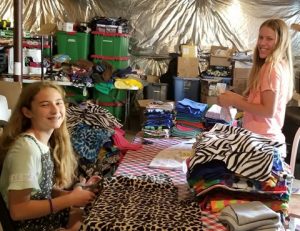
Cadettes Mary and Sofia chose to help animals in their community to earn their Silver Awards. With the guidance of the HSLC Youth Volunteer Coordinator, Juli Bowman, the girls decided to make toys for dogs and cats as well as “adopt me” bandanas.
The girls spent time researching and developing instructions for making the toys and then collecting the supplies they needed. To their surprise, they received an overwhelming response from their neighborhood to provide the supplies. They were able to make over 100 feathered wine cork toys for cats, over 80 fleece heart toys for dogs, and hundreds of bandanas.

Excess supplies were offered to other groups to use in the same way. HSLC will be able use the detailed directions the girls created for future youth volunteer activities.
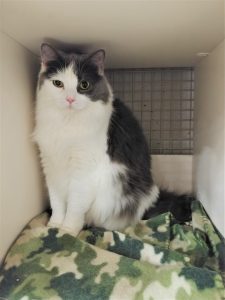
Mary and Sofia told us the feather toys were well tested with their pets and, as you can see, one of our foster kittens totally agrees.
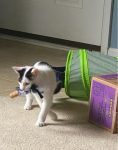
“We were so happy that we got to help pets in foster homes and connect with the community. We hope that our project will help the pets get adopted faster and give them something to play with while they wait in foster homes.”

Because the Humane Society of Loudoun County is a foster-based rescue – WE NEED FOSTERS – especially dog fosters. Fostering saves lives. If you have ever thought about fostering, now is the time. We need your help to help them.
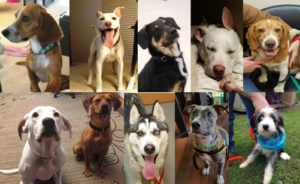
HSLC rescues both cats and dogs. The problem we have right now is our lack of foster homes for dogs. Over the last few years we have helped many dogs from some overcrowded shelters – all sweet, loving dogs that just needed an understanding foster to teach them what it means to be loved. Right now we can’t take in dogs because we don’t have fosters. The picture below is of some of the fabulous dogs we have helped.
How do you foster a dog or cat without getting attached? You don’t. You love them with all your heart. From the minute you bring him home, there’s no better feeling than getting him out of the shelter, giving him his first hug, cleaning him up, and watching what happens when he finally finds out what family is and starts to fall in love with the world.
Sometimes it just takes a few days, and sometimes it takes months. But when his fur shines and he’s smiling nonstop, that’s when you know your job’s almost done. You’ll want to keep him. You’ll cry. You’ll say no one is good enough for him. But when you see him with his new forever family, and see the love in their eyes, you’ll know that you gave him this life and he gave you the sweetest memories. You’d much rather cry over him going home than over him being stuck in a shelter.
The house might be empty without him but that just means one thing – there’s room for someone else who needs you, who will steal your heart all over again.
(adapted from “The Dodo”)
Contact us at foster@humaneloudoun.org for more information about fostering or visit https://humaneloudoun.org/adopt/fosters-needed/
By Valerie Burton
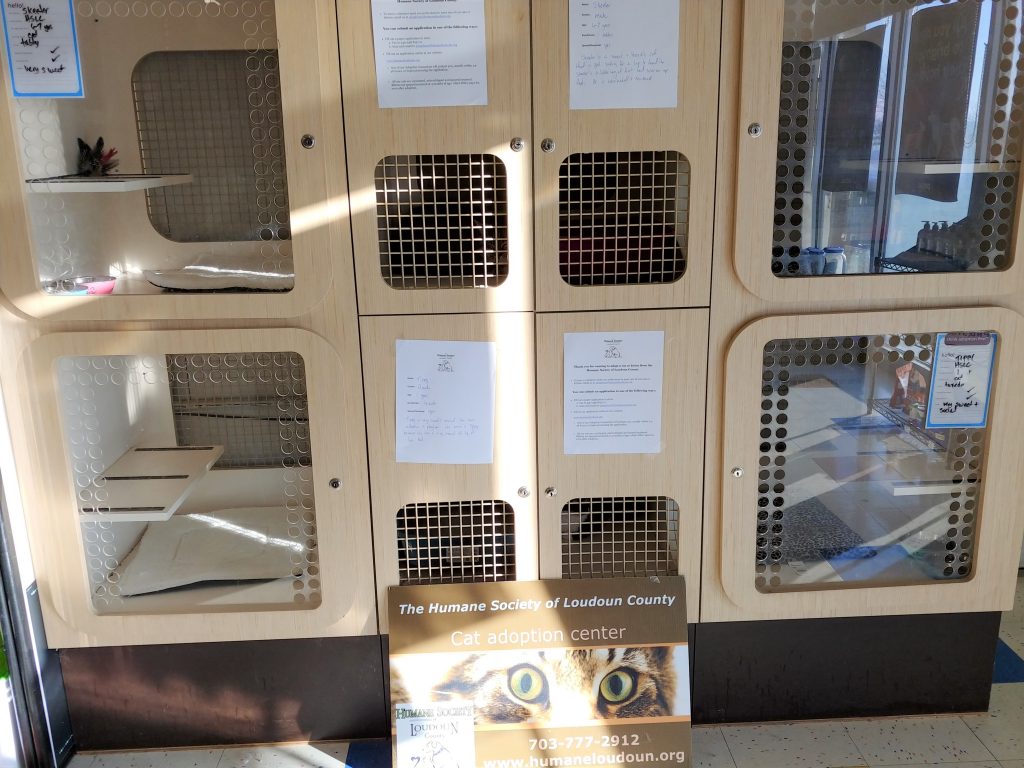
Have you ever been wandering around Petco and seen some adorable cats living in luxurious digs? We caught up with Donna Drake, HSLC’s Animal Director and board member-at-large, to give us the inside scoop on the cat condos.
HSLC: What’s the story of the cats at Petco? How do they get to live in the condos?
DONNA: We carefully screen the cats that are placed at Petco for their suitability for the location. Timid, shy, high energy or aggressive cats aren’t placed there because of the stress of confinement, the noise, and the amount of people stopping by to look. The ideal candidate is a friendly, very social cat who loves attention and will come to the front of the cage when people stop by and try to get folks to interact with them by sticking their paws through the holes in the plexiglass or by meowing for attention.
HSLC: Who takes care of them?
DONNA: I am one of a small group of volunteers, 6 or 7, most of whom have taken daily care of the cats on rotational basis since HSLC took over the Leesburg Petco cat condos in December 2019. We provide food, water, clean the litter and cubbies, make sure the bedding is clean and that the cats are ok and healthy. We will also take them to vet appointments and facilitate meet and greets with potential adopters. Most importantly, we spend time giving them lots of love and attention. In addition to taking care of the cats, we promote HSLC and our other adoptable cats to anyone who stops by to look at them as we take care of them.
HSLC: Do a lot of cats find homes by showing off their personalities living in the condos?
DONNA: The Leesburg Petco store is a great location for marketing HSLC’s adoptable cats! The condos are located near the grooming salon and visible from the check-out stations, so they get lots of exposure and attention from customers in the store. The Petco staff is great at promoting our cats to their customers, and also give them lots of attention. We have adopted lots of cats out of these condos since we took them over. Since the condos are fairly roomy with separate cubbies for food, litter, resting and hiding, we’ve been able to put some bonded pairs in them and get them adopted. Both the HSLC volunteers and the Petco staff become emotionally attached to these cats and highly invested in seeing them find forever homes!
HSLC: Do the cats ever need a break from all that attention?
DONNA: We do try to rotate them out to a foster home after a couple of weeks so that they get a week or two cage break. This is another opportunity for people to do short-term fostering for us!
HSLC: How can people get involved, in addition to fostering and adopting?
DONNA: Leesburg Petco is now our only venue for showcasing our adoptable cats, besides online or at in-person events. This is why it is so important that we have volunteers to help care for any of our cats located in the condos. We are always looking for volunteers to help care for these kitties. It doesn’t take a lot of time or effort, and the cats are so grateful for the attention!
HSLC: Great, so interested people should go to the HSLC website and sign up to volunteer, foster or adopt!
Donna, thank you so much for shedding light on the story of these cat condos! You are making a huge difference in the cats’ lives, and we’re sure if they could they’d say THANK YOU for all you and the other volunteers are doing to find loving homes for them!
It’s remarkable the way a love of animals can really bring a community together. I’ve always kind of known this but was reminded of it in a big way over the past few weeks.
Looking for scraps
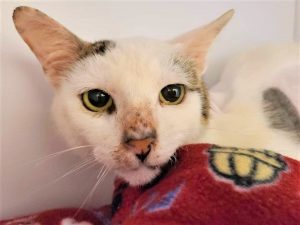
There’s this little shopping center right off John Mosby Highway that I have frequented for a while now. As far back as about a year ago, I remember occasionally seeing this little white cat with brownish-grey markings dart in and out of the alleys and dumpsters. I took note that he was all alone; I didn’t see any other cats around every time I visited. Of course, it broke my heart to see him patting through the dumpster bags on the ground, presumably looking for scraps. However, I figured since cats are so resilient and it’s not uncommon to see strays, that I should just leave him alone.
A very worrisome limp
A few weeks ago, however, I saw the cat again; but this time I grew worried. I noticed he was limping badly, his front right paw was twisted almost backwards, and he just looked to be uncomfortable. It was very difficult to see him struggling. I scrambled to find a little can in my car and filled it with what was left in my water bottle and placed it on the ground in hopes the cat would find it, and I left.
Calling in the cavalry
That evening, I did the only thing I knew to do – I reached out. After posting about the cat on a local Facebook group, I immediately received responses from both Donna Drake and Jennifer Reed from the Humane Society of Loudoun County (HSLC). They were so kind and responsive, asked me questions about the animal and location, and I sent photos and videos whenever I could. I’m not experienced in capturing animals, so I was advised to notify them right away the next time I saw the cat. Luckily, it didn’t take too long before I was able to signal them to send someone out. They sent Sharon Nylec, a very experienced trapper, and, like Donna and Jennifer, a long-time HSLC foster mom and volunteer.
Safe and sound
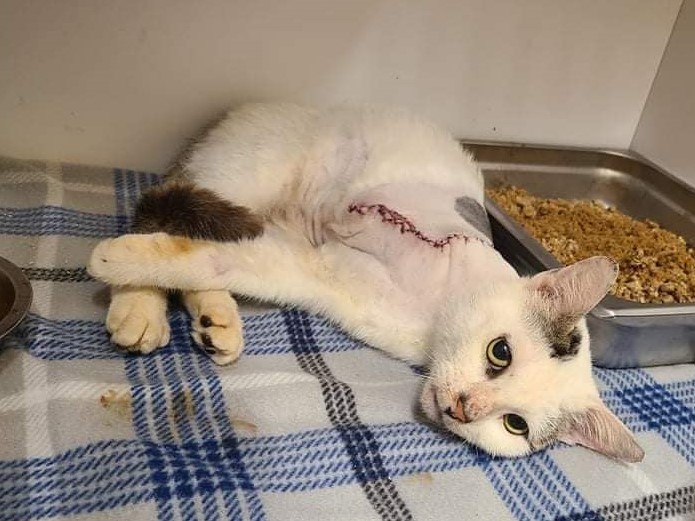
The next morning, I received a photo of the cat in a cage with the good news that he had been captured. He was taken to the vet later that week for treatment. The vets at Harmony Hill Animal Hospital cleaned him up, gave him food and water and, very importantly, some much needed love. Though his right leg had to be amputated, he is now in recovery and safe from any harm that might have befallen him had he been left out with an injury and no sustenance.
A plea for help
It is all thanks to the generosity and empathy of Donna, Jennifer, Sharon, and the vets involved, that little “Pye” as he has been named, will now have an opportunity to thrive. If you’re interested in helping to cover Pye’s medical expenses, including his operation, or those of the many other animals that HSLC has under its wings, I urge to make a donation today. HSLC is an all-volunteer organization and the number of animals they rescue is directly proportional to the amount of money they can raise.
It takes a village
This story has a happy ending because fellow animal lovers banded together and took action. It’s amazing what can be done when we all work as a team. I have never met Donna, Jennifer or Sharon in person, but I feel a small kinship with them in that we shared this experience. This is why volunteers are important. The Humane Society of Loudoun County is important. The entire operation needs our support, so that animals who cannot speak up for themselves have a chance at a happy and healthy life.
-Courtney Siegert

By Heather Nokes
As a pet parent, it can be hard to figure out how to do what is right for our beloved fur babies. This is especially difficult when deciding whether to spay or neuter your pet. The idea of putting your pet under anesthesia is scary, so why risk it? The fact is that the pros greatly outweigh the cons. From the health of your pet to helping your community, there are many reasons why spaying and neutering your pets is a great decision.
- Health
According to the ASPCA, spaying a female cat or dog before their first heat cycle helps prevent 50-90% of these animals from experiencing malignant mammary or ovarian masses and uterine infections, referred to as pyometra. This is also the case with prostatitis and testicular cancer in males. Don’t we all want our pets to be as healthy as possible?
The Humane Society of the United States reports that spaying and neutering also correlates with a longer lifespan. For instance, cats live 39-62% longer when altered while dogs around 20% longer. This means more time with your beloved companions!
- Behavior
As if the health of our pets was not enough, spaying and neutering also shows a major shift in behavioral issues for cats and dogs. Why is this? When in heat, females tend to not only be more vocal, but they can also mark their territory with urine. This is to attract males for reproduction but is often unacceptable to pet parents. Males also tend to practice urine marking and can have a tendency to run away to find a mate; this can lead to unwanted damage to your property, unplanned litters, and even death for the animals that escape.
- Cost Effectiveness
Upfront, the cost of spaying or neutering can seem like a lot. However, if you consider how much healthier your pet is likely to be because of these procedures, it is worth the cost. For example, an unaltered female is up to 90% more likely to develop an infection of their uterus, aka pyometra. Surgery to correct a pyometra is usually done on an emergency basis which increases costs significantly compared to a routine spay surgery. This is also the case with the expenses to treat mammary or testicular cancer. And, of course, one animal is much less expensive to care than a litter of unwanted offspring.
- Community Welfare
As mentioned before, intact animals are more likely to roam in search of a mate. This means leaving their home and going wherever their senses tell them to go in order to reproduce. Often, they do not take into account such things as traffic, wildlife, and people that are not familiar with small animal behavior. These animals walking into traffic can cause car accidents. They also tend to prey on wildlife whether it be for sustenance or to protect themselves. And lastly, loose dogs and cats can be scary to those unfamiliar with them, such as children or the elderly.
- Unwanted Animal Population
The most important reason to spay and neuter, in this author’s opinion, has to do with the sheer number of homeless animals. According to the ASPCA, over 1.5 million animals are euthanized in the United States annually. To break it down even further, this means 670,000 dogs and 860,000 cats are killed every year across the United States. While a small percentage of these cases may be due to health or behavioral issues, most of these animals simply cannot be cared for. By leaving your animals intact and able to breed, you could be contributing to this number of homeless and euthanized pets.
The five reasons listed above are more than enough proof that fixing your pet is beneficial to not only the animal, but to you, other animals and our community. Understandably however, surgery and cost can still be an issue for some owners. If you find that you have questions or concerns about spay or neuter procedures, your veterinarian should be able to help ease your mind.
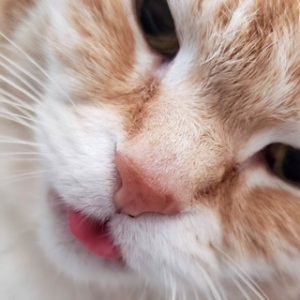
by Amy Richards
One of the best things to come out of the previous years is the story of how #MargoTheComebackCat came to the Humane Society of Loudoun County and made all of our hearts grow. It all starts in May of 2019 when we were picking up a senior cat from a shelter in Maryland. While we were on our way, we received a plea asking if we could take another senior cat while we were there. Upon learning more about this sad, surrendered soul, there was no way we could turn our backs on her.
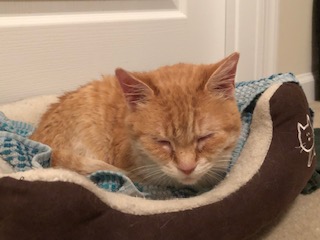
Margo was an owner-surrender due to allergies and was just one day from being euthanized when we rescued her from the overcrowded shelter. Stressed and nearly blind due to high blood pressure, Margo was shutting down in the shelter environment. She was in dire need of a second chance. After spending a few days between a foster and one of our trusted veterinarians, it was even more clear that she desperately needed a single, soft place to land and rediscover herself. Thankfully a former adopter offered up their extra bedroom to see what a little TLC could do for this old gal.
It was a slow and scary start. Margo was so severely depressed that she wouldn’t eat and had trouble walking from arthritis. Her blood pressure was so high that her vision was a serious issue. After days of force-feeding, Margo started to show some signs of life. A few weeks of gaining her trust by being present for her and providing more treats, she continued to open up. Soon, she was happy to receive affection. She enjoyed brushings. And she even started to take treats by hand. Margo then made fast friends with the furry foster family members and became eager to spend time with the entire family. She would meow as soon as she heard everyone up for the day and even learned to manage the stairs! The family created a game called “Margo Polo” to make sure she could follow their voices to find them wherever they were in the home.
Margo had regular vet appointments to monitor her blood pressure which got under control with medication and lower stress living. She also began laser therapy to help soothe her arthritic joints. She was eventually able to turn around without falling over! With the improved blood pressure, also came slightly improved vision. Our former lost soul truly blossomed into #MargoTheComebackCat.
There were still some bumps in the road and some potential homes that fell through, but no one gave up hope. Everyone knew that the purrfect home was out there somewhere, and Margo’s time would come. And sure enough, she was seen on a courtesy post through the Facebook page NoVa Cats. Her future momma was looking for a lounging lap cat, and Margo fit the bill to purrfection!
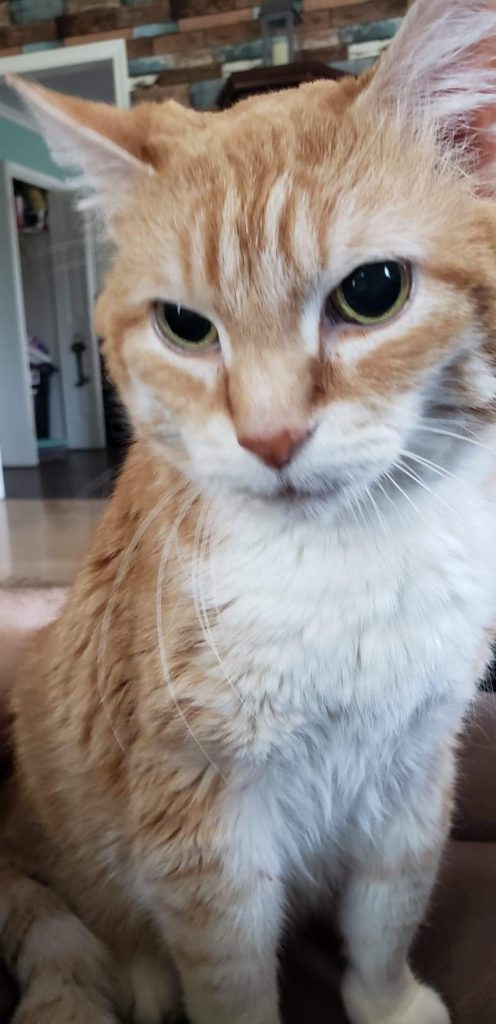
Welcomed into her furever home on March 01, 2020, Margo has been loved and pampered by her family.
Her mom Scarlett reports:
Margo is a cuddly bug. She just wants a nice place to lay even though she lays crazy. She is veryyyy stubborn and will let you know when she is done with your buffoonery. She is a little old lady making her laps in the mall everyday. She walks around the kitchen table and living room table maybe 5 or 6 times each and is very vocal when you are blocking her path. She likes to scratch the doorframe but [my husband] says it’s okay because she is funny. She eats with lots of head bobbing that’s hilarious to watch. She KNOWS when I’m up in the morning and she is awaiting her food, but she will stay knocked out when the dogs bark/vacuum/any loud noise. And even though [my husband] wasn’t sure about getting another animal when we did (with moving into a new house and all) I catch him cuddled up with her all the time. She LOVES laying on our bed. If she could easily get up and down, we would leave her up there all night. She gets around really well for her vision being what it is.
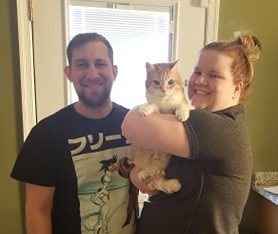
We couldn’t share success stories like Margo’s without the support of our amazing community and team of volunteers. Thank you for your contributions and continued support of the Humane Society of Loudoun County.
To learn more about Fostering and Adoption through the Humane Society of Loudoun County please follow this link: Humane Society of Loudoun County.
To learn more about the joys of adopting a senior pet please read the following: Why Adopt a Senior Pet.

While 2020 was full of societal obstacles, The Humane Society of Loudoun County managed to produce record breaking numbers throughout the year. Just look at our numbers! Thank you to everyone who has helped make these numbers possible. We look forward to building on our momentum and having an even more successful 2021.
Breaking It Down
We Rescued: 336 dogs and cats most of which were adopted into their “furever” homes.
We Saved: 82 animals from euthanasia.
We Improved: the lives of 310 community cats through our TNR program,
We Helped: 927 pet owners save money for spaying and neutering their pets.
We Also Helped Deliver: 24,000 lbs of donated pet food to the Loudoun Pet Pantry at Loudoun Hunger Relief helping nearly 4,500 pets.
We’re Keeping: both feet on the gas pedal to achieve another record breaking year in 2021.


For our quick Volunteer Spotlight, we sat down with Davy Fogler and asked him a few questions about his volunteer experience.
How long have you been a volunteer for the Humane Society of Loudoun County?
I’ve been volunteering since March 2020.
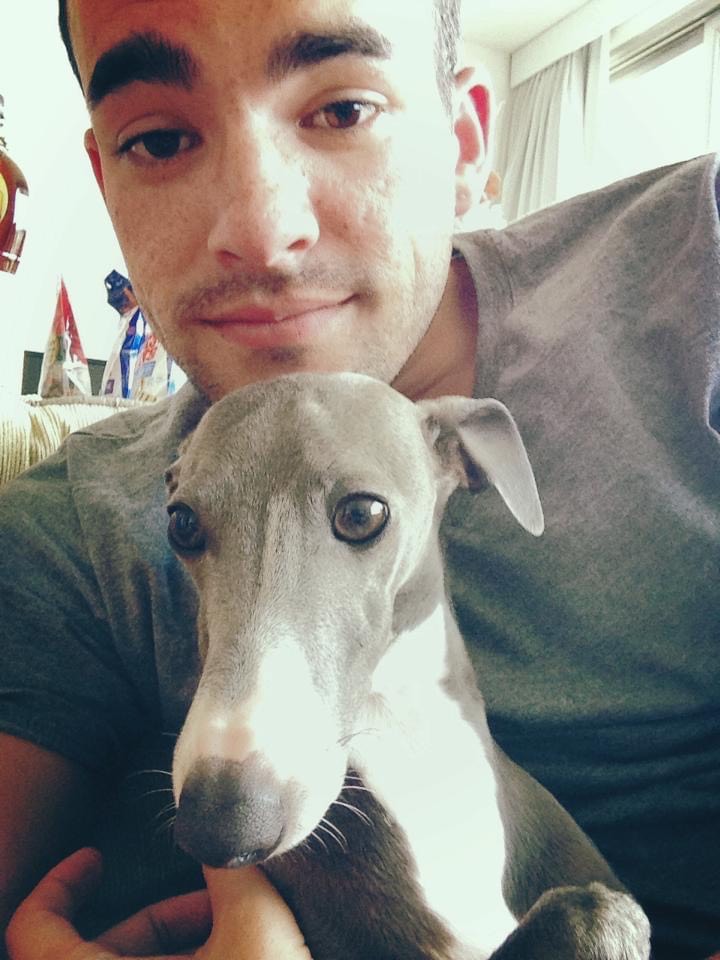
What made you decide to start volunteering?
I started volunteering, like many others, during the initial Covid shutdown – and chose HSLC because I love animals and enjoy working as part of passionate teams. I also really enjoy making processes more efficient, so helping the adoption and foster teams seemed right up my alley!
What is your role?
Well, I started on the Adoption Team, helping to streamline the adoption application tracking process and the foster tracking process.
Oh! What is your role now then?
After helping the adoption and foster teams, I really wanted to find a way to be more engaged on the volunteer side and applied for the role of Orientation lead. I felt that sharing my passion with potential volunteers and helping streamline the onboarding process was another positive way I could give back to the community. I became Volunteer Orientation Lead in May 2020, and managed the virtual onboarding of new volunteers.
Board Vice President, Christina Levendosky, asked if I would be willing to take on the role of Volunteer Coordinator after a few months of leading orientations, and I officially became the program lead in November. In my new role, I recruit, train, engage, and acknowledge all the HSLC volunteers. I also coordinate the bi-monthly volunteer newsletter to help get information out.
What’s your favorite part of your position?
My favorite part of being the VC is getting to interact with all the different pet lovers throughout Loudoun County, and being able to see firsthand the impact that HSLC makes.
What are your goals for the Volunteer Management Program this year?
I want to increase engagement with our current volunteers because it has been hard with the pandemic to connect with each other. I also want to increase the number of volunteers we have to allow us to save more animals.
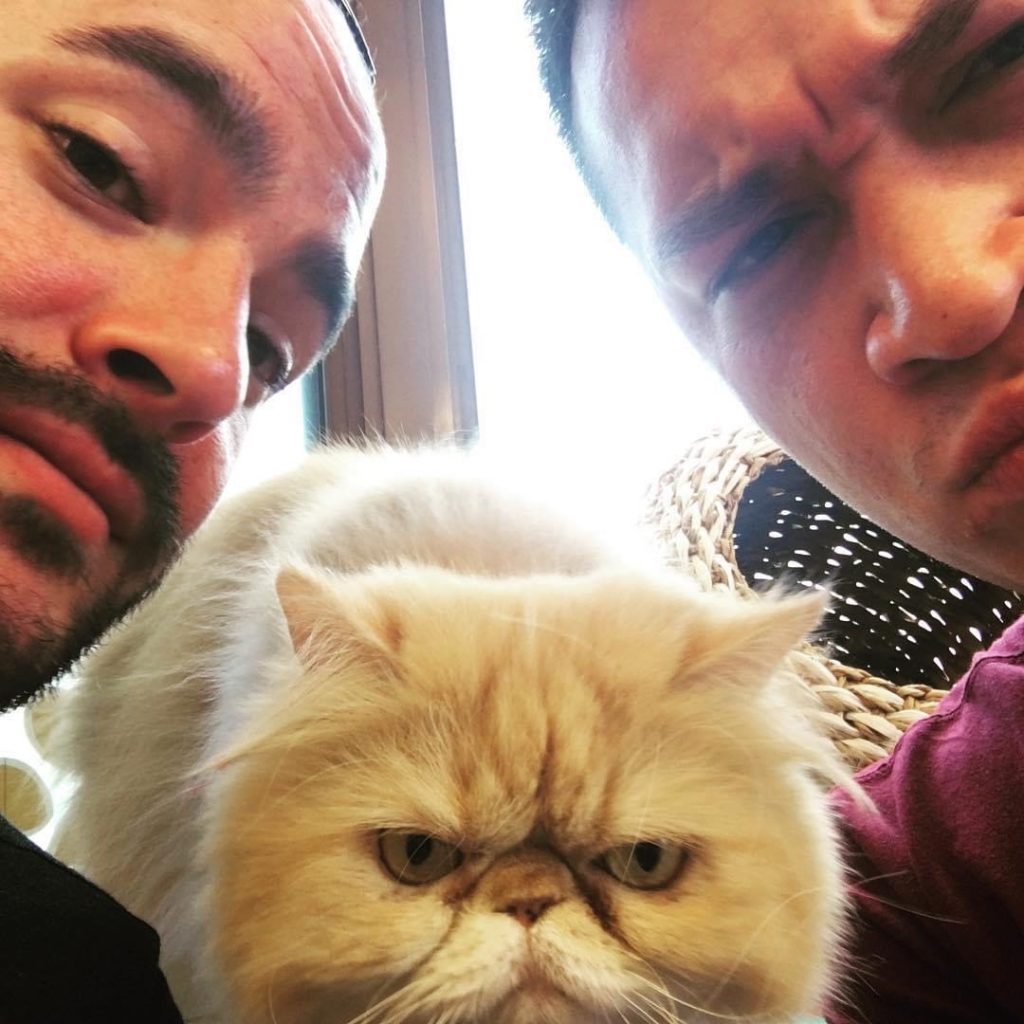
Any advice for potential volunteers?
Don’t be afraid to try new things! HSLC is super accommodating and will let you try out different roles until you find your place.
To learn more about volunteering with HSLC, please visit our website.
by Heather Nokes
Have you ever been to a shelter or looked at adoptable pets online, and most of them seem older? Distinguished grey faces. Lovely cloudy eyes. Unfortunately designated retirement homes for these pets are rare, so these animals need a loving home to live out the rest of their golden years.
What do we mean by “senior?”
Dogs are considered senior between the ages of 7 and 11, depending on size; while cats are considered senior at the age of 10. It is often at this time that they begin showing age-related changes: loss of vision, loss of hearing, weight gain, loss of energy, and/or arthritis and other joint problems. These changes are common reasons for senior pets to be surrendered to rescues and shelters. While these ailments might seem daunting, most of them are easily treated with regular veterinary care and medications. Love and patience also help!
What you see is what you get!
When first adopting a pet, it is most likely that you will want to get to know them. With senior pets, they have an established personality and, as AdoptaSeniorPet.org says, what you see is what you get with a senior pet! In comparison to a puppy or kitten, you do not need to wait months for their personality to blossom. It is also more likely that senior pets have experience with people, just as a seasoned pet owner does with animals. They know what they like just as you do. Again, what you see is what you get!
Senior pets also tend to be more loyal. They are grateful to be around people, to have toys, and to be fed. It is not hard to please them. They tend to be more relaxed than a young pet; napping and eating all day is enough for them to be happy. Unlike puppies and kittens, senior pets do not demand constant attention. They don’t need to play as often, and they do not need as much training!
Save a life!
Possibly the best reason to adopt a senior pet is the fact that you are saving a life. Many senior pets in rescues and shelters don’t find a home due to the fact that they are not as outgoing and active as younger animals. They just don’t “stand out.” This also means that they tend to be euthanized if health issues arise or if space in the shelter is needed. By adopting a senior pet, you are quite literally saving a life while making your life more fulfilling in return. Be a hero and adopt a senior pet!
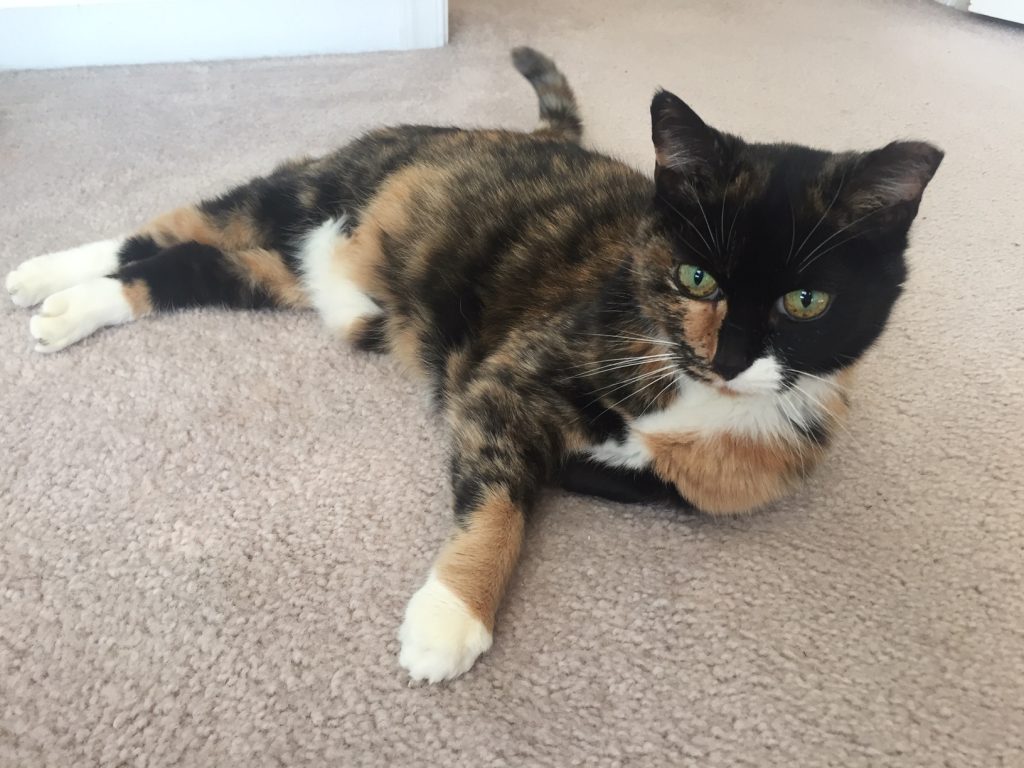
Despite a record number of adoptions this year, there are still many senior pets–like Lily pictured here–who find themselves without homes at rescues and in shelters across the U.S. Find our available animals here. Keep in mind that animals are added periodically so always check back!
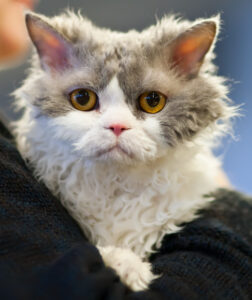
That’s right, there’s a whole month dedicated to the love of our furry feline companions. It is widely believed that cats domesticated themselves by recognizing the abundance and ease of catching prey near human agricultural developments. They essentially chose us, and we are better for it.
Studies have shown that cat owners may experience better mental health than individuals without pets. Cats are great stress reducers. Just 15 to 30 minutes of quality time with a cat can calm your nerves and boost your mood. When you spend time with a cat, your production of serotonin (a chemical that boosts feelings of well-being) goes up, and your cortisol levels (a buildup from stress) go down. Adults and children alike report feeling happier and having more positive feelings if a cat is part of their family. How could you not feel better with a purring ball of fur curled up beside you? And, if you adopt from an animal rescue or shelter, you will feel extra warm and fuzzy that you just saved a precious little life.
If the prospect of warm fuzzies isn’t enough, the Humane Society of Loudoun County has laid out five more reasons cats make great pets.
-
They’re Fairly Self Sufficient
Remember, they chose us. Cats have remained fairly unchanged genetically, meaning they are still capable of living in the wild (but we do discourage allowing domestic cats to roam outside). Cats are still incredibly low maintenance, and very independent, and self-sufficient. Cats also groom themselves, so they don’t need frequent baths. We do, however, recommend they have their teeth and ears cleaned regularly.
-
Small Space, No Problem
Cats are also perfect for apartments or city living. They don’t need a huge backyard or tons of space to play and explore. They are content with nosing their way through the nooks and crannies of your home. As long as you give them plenty to do and have toys available to keep them entertained, cats are happy. A living space and a basic feather toy might be all you need to make playtime a breeze.
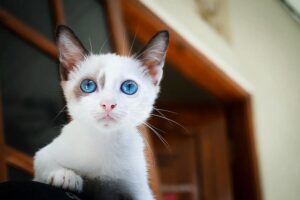
Cats can often adapt easily to smaller living environments if you give them a lot of vertical space to move around in, such as cat trees and cat “shelves” that are mounted on the wall.
-
Housebreaking Made Easy
Cats are really good at learning potty training on their own. They like to have their own space and privacy so provide one litter box per cat, plus an additional box, and kitty litter, and they will be happy.
-
Shhhh
Worried that bringing a pet into your home might disrupt things? No worries! Cats are relatively quiet animals; they are almost always in stealth mode. Yes, they’ll meow every now and then, but you don’t have to worry about them barking or even making much noise when they walk.
-
They Bring the Love
The main reason people become pet owners is because of an innate love or affinity for animals. Cats bring tons of love and joy into a household. They are wonderful pets and companions.
If you want to take part in National Cat Lovers Month, please consider adopting through the Humane Society of Loudoun County. There are plenty of cats available for adoption so make sure you take the time to read through all the available information on our website in order to make a fully informed decision. Your future cat companion may be just a click away!
Bonus Way to Celebrate National Cat Lovers Month:
FOSTER
While fostering is still a commitment, it is a more temporary way to help out an animal in need. Your individual attention will give a cat a boost of confidence until it finds its forever home. And if you are interested in fostering, consider fostering a senior cat, a special needs kitty, or an orphan kitten. Follow this link to learn more about fostering through the Humane Society of Loudoun County.