

By Joan Cassell
With the recent snowfall here in Loudoun County, this is a good opportunity to take a mid-season look at your pet’s cold weather needs. If you think about it, your pets have the same basic requirements that you do: shelter, safety, water and food. So, whatever you do for yourself in winter, your pets will probably need something similar.
Outdoor Time
Like people, dogs are susceptible to frostbite and hypothermia and should be kept inside when the temperature is below freezing. Although many pets have thicker fur during the winter months, it is a common misbelief that dogs and cats are more resistant to cold weather than people because of their fur.
Short periods of outside time is great for exercise and will keep your dog* from getting bored. If you have a pet with a short coat, there is no shortage of really adorable sweaters and jackets available. When selecting pet clothing, be sure it is safe, comfortable and made of non-toxic materials. Your fur baby should be able to walk, see, and hear clearly.
*The Humane Society of Loudoun County does not encourage allowing domestic cats outside unless they are leash trained or in a contained area like an enclosed porch.
Food and Water
Cold weather and heated homes, especially those without a humidifier, can make pets extra thirsty. So, keep your pets hydrated by ensuring their water bowl(s) are always full and readily accessible year-round. If you have outdoor water bowls, check them daily to make sure the water hasn’t frozen.
Keeping warm uses more calories, so even short periods of outdoor play may require more food intake. If exercise does not increase significantly then you can maintain your pet’s regular food intake. If you have special concerns, as always, talk to your veterinarian.
Hazards
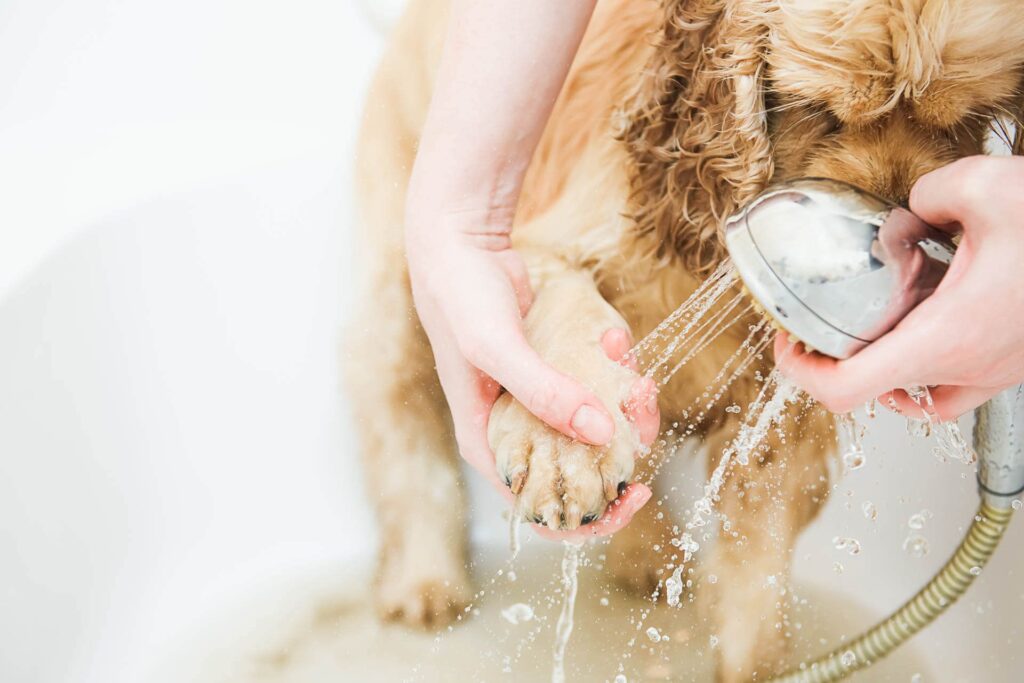
Ice and chemicals on the roads and sidewalks can damage paws. So, it is a good idea to moisturize your dog’s paws with petroleum jelly before heading out. And, be sure to clean those paws and legs after being outside. This will keep your pet from consuming harmful chemicals when they clean themselves. You may also want to consider pet booties to minimize contact with painful or poisonous substances like salt and ice melt crystals.
If your dogs are allowed to run off leash, always keep a very close eye on them to ensure they avoid frozen ponds, pools, lakes or other water sources. Unsupervised dogs may venture out onto a frozen area unaware of the dangers and get stuck in a bad situation. When in doubt, avoid these hazards altogether or keep your dog on a leash.
Lastly, notice your surroundings when you get ready to move your car. Sometimes stray and feral cats as well as other animals sleep in or under vehicles to stay warm. Before starting your car, honk the horn or bang on the hood to give any animals in or around your car a chance to escape.
Enjoy the outdoors with your pets for what is left of winter!
Looking for a cuddle buddy to snuggle with this winter? Consider fostering or adopting.
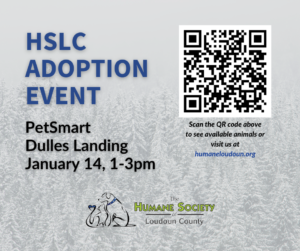
Come meet our adoptable animals live and in-purr-son at HSLC’s next adoption event! We’ll be at the Dulles Landing PetSmart from 1pm to 3pm on Sunday, January 14th. For a sneak peek of our adoptable animals, please visit the Humane Society of Loudoun County website!
If a particular fur-baby (or two) catches your eye, complete an application today to expedite the application process.
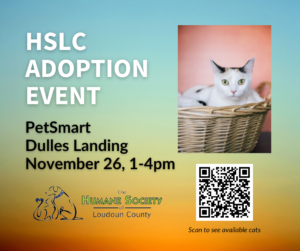
Come meet the animals hoping to find a home for the holidays! Please visit the Humane Society of Loudoun County website to check out the current crew!
If a particular fur-baby catches your eye, complete an application today to expedite the application process.
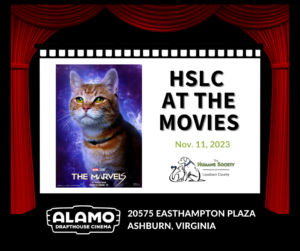
The Humane Society of Loudoun County (HSLC) will be at the Alamo Drafthouse at One Loudoun for The Marvels.
Any Marvel fan knows that Goose the “cat” steals every scene she’s in! So, we’ll be bringing some of our own scene-stealing kitties for you to meet. We’ll also be offering HSLC merch in support of our life-saving mission!
For times and tickets, visit the Alamo website.
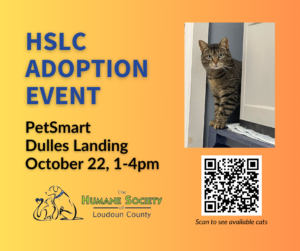
Come meet our adoptable cats and kitties live and in-purr-son! For a sneak peek, please visit the Humane Society of Loudoun County website to check out the current clowder!
If a particular feline (or two) catches your eye, complete an application today to expedite the application process.
By Kathleen Silver
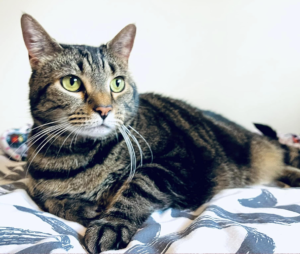
Recently, a kitty adopted from HSLC four years ago was returned to us. Unfortunately, Mindy’s family developed allergies and couldn’t keep her. Mindy, a gorgeous Tabby, also has one issue other than needing a new home: Obesity. She can’t effectively clean herself with so many extra pounds. Her coat was matted and dull by the time she came to HSLC. Mindy’s foster parent supposes that her previous home may have free-fed the companion animals in the house; therefore, it’s likely that Mindy snacked — a lot.
A Little On Obesity
Attempting to get a food-driven kitty like Mindy not to overeat may be challenging. After all, it can be difficult to resist the constant meowing and big round eyes. But obesity in cats and dogs is one of the top dangers leading to diabetes, intra-abdominal cancers, heart disease, and hypertension. Furthermore, with disease comes extra veterinary costs for medications and tests and an increased risk of complications from anesthesia if a pet ever needs surgery. Obesity is common in older indoor pets that are not as active as they were in their early years and can lead to osteoarthritis, degeneration of joints, and bladder stones. Overweight pets are more likely to have shorter lives and tend to interact less with their families physically. They can be more lethargic, so it is easier to miss early signs of illness.
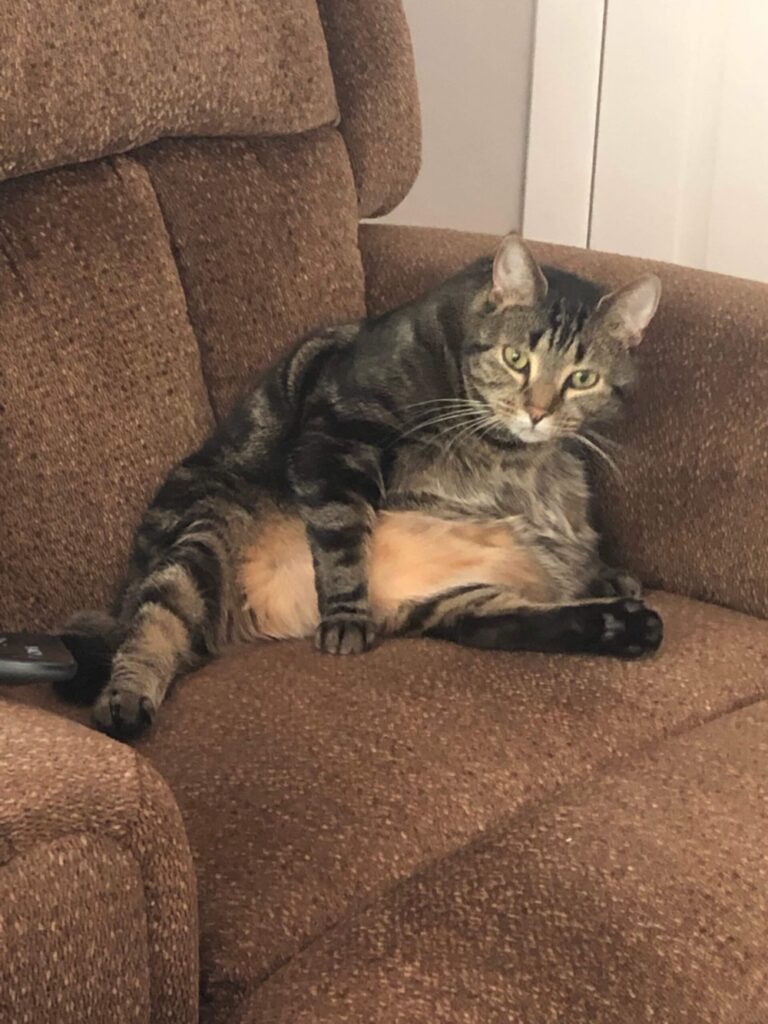
When a cat or dog is heading toward severe weight gain, it is time to acknowledge the situation. It is imperative to consult with a veterinarian on the correct approach to helping your companion animal lose or maintain weight so obesity doesn’t creep into their life. Simply cutting the amount of food may not be the ideal approach. It’s possible to cause a cat or dog to become malnourished by cutting food. What’s best is to talk to your veterinarian about the type, frequency, and portion sizes of the new food to facilitate weight loss. Then, it is the pet owner’s job to be consistent with the food and resist the temptation to give treats.
Introducing a pet to a new food takes time. Most pets like their routine, and changing it can cause them to retreat and become moody. Take the first 2-3 weeks to mix their everyday food with the new food. The goal is to wean them off the old food and habituate to the new, healthier diet.
Exercise is another feature to help an obese or overweight animal. However, exercise must begin slowly if the pet usually doesn’t move much. Even if a cat or dog lays on its back batting at a toy — that’s some exercise! Many people might say, “My pet won’t play.” But, with some trial and error, you will find an activity that your pet will enjoy. Once you find it, commit consistently to playing with your cat or dog for 5-10 minutes daily, more if possible. As time passes, your pet will eventually become more interested and may even seek you out for a few more minutes of playtime.
Back to Mindy’s Story
As for Mindy, she now eats a special low-carb diet to give her the best life possible and to reduce her weight. Mindy’s foster parent, Stephanie, reports that in only four weeks, Mindy’s coat has regained most of its former sheen, and she’s back to grooming herself.
Mindy is great with children and other cats; she tolerates dogs. Miss Mindy always finds a way to curl up on a lap. She craves attention and loves cuddling. However, Mindy won’t do well with a home that free feeds. She will need her meals on a schedule. Stephanie also says she doesn’t beg for food between meals, likely due to the high-quality food she’s now eating.
Mindy plays with toys and loves to interact with people and children. She has the most fun chasing plush toys with sounds or bells and hunting ribbons and string. Mindy is very friendly and ready to find her new home.
February 2023 Update: Mindy has been adopted! However, you can click here if you’re interested in adding one of her friends to your family!
As a foster-based, all-volunteer organization, the Humane Society of Loudoun County relies on the community to provide homeless animals the second chances they deserve. Here are five “paw-some” ways to help our furry friends this holiday season.
1. Go Shopping
When you do your holiday shopping at Amazon Smile, please designate The Humane Society of Loudoun County as your charity. While on Amazon, be sure to check out our kitten registry and charity wish list. We also have a wish list on Chewy.com.
2. Support Giving Tuesday
This international day of giving on November 29 is the perfect time to “paws” and make a life-saving donation to HSLC. The more funding we have, the more animals we can help!
3. Become a Guardian Angel
Maybe you’ve fallen in love with one of our animals but can’t adopt. Or perhaps you see a cat or dog that has been on our website for a while but hasn’t been adopted. Sponsoring an animal’s adoption fee, in part or full, will increase the odds that they will find a loving “fur-ever” home in the near future.
4. Donate Your Vehicle or Property
Got a vehicle you want to unload before the new year? Consider donating it to HSLC. We offer free pick-up for donated vehicles of all types—cars, trucks, boats, and even ATVs. We also launched a real estate donation program this year to support our life-saving mission.

5. Give through a Donor Advised Fund (DAF)
More and more supporters are using DAFs to manage their charitable giving. They combine the most favorable tax benefits with the flexibility to support your favorite causes, like HSLC.
Thank you for helping animals in need this holiday season and throughout the year.
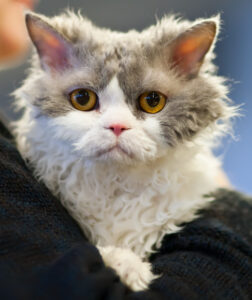
That’s right, there’s a whole month dedicated to the love of our furry feline companions. It is widely believed that cats domesticated themselves by recognizing the abundance and ease of catching prey near human agricultural developments. They essentially chose us, and we are better for it.
Studies have shown that cat owners may experience better mental health than individuals without pets. Cats are great stress reducers. Just 15 to 30 minutes of quality time with a cat can calm your nerves and boost your mood. When you spend time with a cat, your production of serotonin (a chemical that boosts feelings of well-being) goes up, and your cortisol levels (a buildup from stress) go down. Adults and children alike report feeling happier and having more positive feelings if a cat is part of their family. How could you not feel better with a purring ball of fur curled up beside you? And, if you adopt from an animal rescue or shelter, you will feel extra warm and fuzzy that you just saved a precious little life.
If the prospect of warm fuzzies isn’t enough, the Humane Society of Loudoun County has laid out five more reasons cats make great pets.
-
They’re Fairly Self Sufficient
Remember, they chose us. Cats have remained fairly unchanged genetically, meaning they are still capable of living in the wild (but we do discourage allowing domestic cats to roam outside). Cats are still incredibly low maintenance, and very independent, and self-sufficient. Cats also groom themselves, so they don’t need frequent baths. We do, however, recommend they have their teeth and ears cleaned regularly.
-
Small Space, No Problem
Cats are also perfect for apartments or city living. They don’t need a huge backyard or tons of space to play and explore. They are content with nosing their way through the nooks and crannies of your home. As long as you give them plenty to do and have toys available to keep them entertained, cats are happy. A living space and a basic feather toy might be all you need to make playtime a breeze.
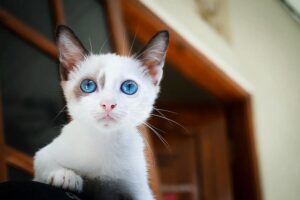
Cats can often adapt easily to smaller living environments if you give them a lot of vertical space to move around in, such as cat trees and cat “shelves” that are mounted on the wall.
-
Housebreaking Made Easy
Cats are really good at learning potty training on their own. They like to have their own space and privacy so provide one litter box per cat, plus an additional box, and kitty litter, and they will be happy.
-
Shhhh
Worried that bringing a pet into your home might disrupt things? No worries! Cats are relatively quiet animals; they are almost always in stealth mode. Yes, they’ll meow every now and then, but you don’t have to worry about them barking or even making much noise when they walk.
-
They Bring the Love
The main reason people become pet owners is because of an innate love or affinity for animals. Cats bring tons of love and joy into a household. They are wonderful pets and companions.
If you want to take part in National Cat Lovers Month, please consider adopting through the Humane Society of Loudoun County. There are plenty of cats available for adoption so make sure you take the time to read through all the available information on our website in order to make a fully informed decision. Your future cat companion may be just a click away!
Bonus Way to Celebrate National Cat Lovers Month:
FOSTER
While fostering is still a commitment, it is a more temporary way to help out an animal in need. Your individual attention will give a cat a boost of confidence until it finds its forever home. And if you are interested in fostering, consider fostering a senior cat, a special needs kitty, or an orphan kitten. Follow this link to learn more about fostering through the Humane Society of Loudoun County.
By Heather Nokes (aka Your Neighborhood Vet Assistant)
UPDATE: As of July 1, 2024, both Virginia and Maryland have outlawed declawing in most cases.
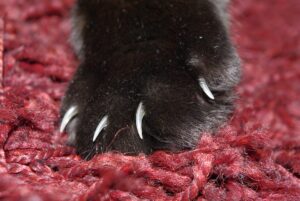
Scratching and clawing behavior is one of the reasons cats are often rehomed or not adopted. While declawing can seem like a viable solution, this controversial procedure actually creates more problems than it solves.
Why do cats scratch/claw?
- To “sharpen” their nails. Like any other animal, cats’ nails are constantly growing. This means that the outer husk of their nail dies off as the new nail emerges underneath. Often, cats scratch things in order to shed this husk. Not only does scratching “sharpen” the nail, it makes the cat feel better.
- To stretch their muscles. If you have ever witnessed a cat scratching or clawing something, you can attest to the fact that they often stretch out their front legs as far as they can go. Like the downward dog pose in yoga, this opens their body up and feels good.
- To mark their territory. When a cat scratches something, it leaves its scent behind on that object. Other cats can smell this and are warned of their trespassing. This is often comforting to the scratcher, especially the insecure ones, and makes them feel more at home.
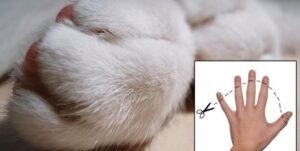
If performed on a human being, declawing would be like cutting off each finger at the last knuckle.
What is declawing?
- The declawing procedure is referred to as an onychectomy. Per Merriam-Webster, this procedure is the “surgical removal of a toenail or fingernail”. However, the surgery itself involves using either a sterile nail trimmer, surgical blade, or laser to literally cut through the bone of the third digit of the toe, which is the bone from which the claw grows.
Why is the procedure so harmful?
- It is very painful. Imagine getting the last digit of your toes or fingers cut off. It would be difficult for you to walk or use your hands and feet for a while after the procedure.
- It can cause complications, diminishing the cat’s quality of life. A cat without claws is unable to defend itself and may become a biter because they no longer have their claws for defense.
- In addition, even when the procedure is done with great precision, it can leave the cat with an altered way of walking which can lead to the development of arthritis.
- For several days after surgery, shredded newspaper is typically used in the litter box to prevent litter from irritating declawed feet. This unfamiliar litter substitute, accompanied by pain when scratching in the box, may lead cats to stop using the litter box.
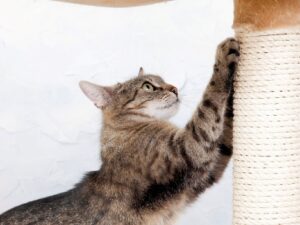
Train your cat to use a scratching post by sprinkling it with cat nip.
What are the alternatives?
- If adopting a young cat or kitten and a scratching problem is noticed, it is important for the owner to train their cat where it is appropriate to scratch, and where it is not. Scratching posts, boards, and furniture are available for sale almost anywhere pet products are sold. Because clawing and scratching is a natural behavior, kittens and young cats that have access to the appropriate scratching tools will use them.
- There are some cats that will just scratch whatever they see first, whether it be a scratching post or your grandmother’s antique chair. There are products that are meant to deter or attract cats from scratching. For example, something as simple as sprinkling cat nip on the scratching post can entice the cat enough for them to scratch there. There is also tape that can be applied to vertical surfaces of furniture. This tape is meant to be safe on furniture but uncomfortable for the cat when they attempt to scratch.
- Nail Caps. Talk to your veterinarian or local pet store employee about nail caps. These are made to fit over your cat’s nails and stay on with glue. Often made of soft plastic, the cat cannot do as much, if any, damage when scratching with them on.
- Frequent Nail Trims. As stated before, cats’ nails are constantly growing. By trimming them every week or two, the cat will not feel the need to scratch as much.
Declawing is illegal in over 40 countries and counting. Several cities in the U.S. have banned declawing. And, last year, New York became the first state to ban the procedure except in rare cases when it is medically necessary. The American Medical Veterinary Association (AMVA) “discourages the declawing (onychectomy) of cats as an elective procedure and supports non-surgical alternatives to the procedure.” HSLC does not condone declawing and will refuse an adoption if the candidate plans to declaw.
By Heather Nokes
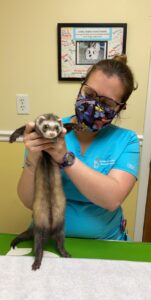
What day is it? Those of us who have been at home for weeks on end are having trouble keeping track. But you know what we are doing? Spending more time with our pets! This means paying more attention to them, their behaviors, and their health. Luckily, veterinary clinics and hospitals are deemed essential businesses. As a seasoned veterinary assistant, this author (see photo) and her colleagues want pet owners to know a few things in this uncertain time.
Our hospitals are just as busy, if not more so, than usual: With people having more free time on their hands, they are able to bring their pet in for routine visits. This is fantastic! However, some veterinary clinics and hospitals are reducing their business hours to protect their staff from exposure. And those hospitals that are running at a normal capacity are filling appointments quickly. It is also important to keep in mind that most of us are doing telemedicine and curbside service which often take up more time than normal office procedures.
We WANT to see your pet… if they are sick: Because of the above listed adjustments, your veterinary hospital may be prioritizing sick visits. This means routine vaccinations and preventative care exams are being put off for weeks or even months.
We act different when you are not around: When we take your pet from you, we understand that it can be nerve-wracking for both you and your fur baby. We take this into account and tend to baby your pet more than you would expect behind closed doors. Not many jobs allow you to use baby talk and cuddles but your veterinary staff is well versed. We do this because we genuinely care for animals and always treat our patients like our very own pets.
At this point, there is no evidence that animals play a significant role in spreading the virus that causes COVID-19: According to the CDC, the risk of animals spreading COVID-19 to people is considered to be low. CDC is working with human and animal health partners to monitor this situation and will continue to provide updates as information becomes available.
Of course, if you have concerns or questions about your pets in this uncertain time, your veterinary hospitals are more than happy to speak with you over the phone. And as always, in an emergency, take your pet to the nearest emergency clinic ASAP!